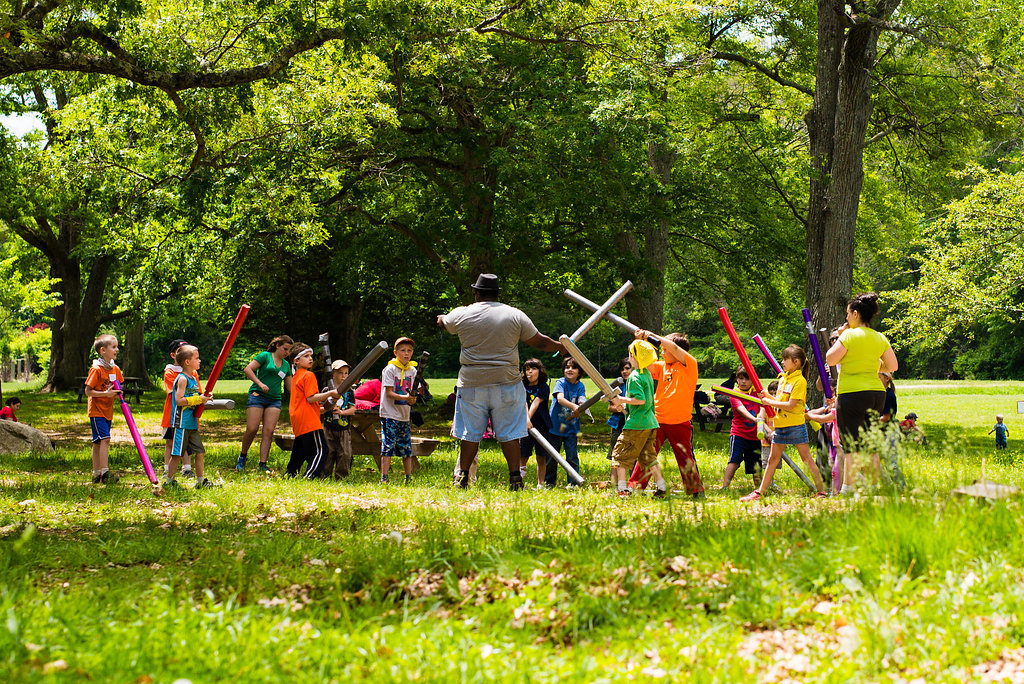
Behind the Scenes: Creating a Percy Jackson-Inspired Mythology Camp
When Rick Riordan published The Lightning Thief in 2005, he sparked something remarkable: millions of kids suddenly wanted to learn about Greek mythology. They didn’t just want to read about it—they wanted to live it. They wanted to be claimed by a godly parent, go on quests, and discover their own heroic potential.
The challenge for us as educators became clear: how do you transform that enthusiasm into genuine learning experiences? How do you create programming that honors both the excitement of Percy Jackson and the depth of actual mythology? Anyone can put kids in orange shirts and call it Camp Half-Blood, but building something educationally meaningful requires intentional design, mythological accuracy, and a structure that lets young people truly inhabit these stories.
Over the years of developing our mythology programming, we’ve learned what works and what doesn’t when bringing ancient Greek myths to life for modern kids.
Starting With the Source Material
The first mistake many programs make is focusing solely on the Percy Jackson books while neglecting the actual myths. The books are a gateway, not the destination. Our design process starts with primary sources—the original myths themselves.
We study Hesiod’s Theogony, Homer’s epics, and the plays of Sophocles and Euripides. We examine how different myths were told in Athens versus Sparta, how stories evolved across centuries, and what these narratives meant to the people who first told them. Only then do we consider how to make these ancient stories accessible to contemporary young people.
This foundation matters because kids notice inconsistencies. They’ll question why your version of a myth differs from what they read. When you can explain that actually, the ancient Greeks themselves told competing versions of the same story—that mythology was never meant to be a rigid canon—you open up space for critical thinking and interpretation.
At Camp Mythos, we use the Percy Jackson framework as scaffolding, but we’re constantly weaving in the richer, stranger, more complex versions of myths that don’t always make it into middle-grade novels. Kids learn that Medusa’s story is more tragic than monstrous, that the Olympians were fascinatingly flawed, and that heroism in Greek myths often looked different than modern superheroes.
Designing the Claiming Ceremony
The moment when demigods are “claimed” by their godly parent might be the most anticipated experience at any mythology camp. It’s also the trickiest to design well.
Early iterations of our claiming ceremony were too arbitrary—counselors assigned cabins based on logistics rather than personality. Kids saw through it immediately. If the magic moment that defines your entire camp experience feels random, you’ve lost something essential.
We rebuilt the ceremony from scratch, developing a system that combines observation, self-reflection, and genuine surprise. Throughout the first day, counselors observe how campers approach challenges, interact with peers, and solve problems. We don’t use personality quizzes—those feel too clinical. Instead, we watch: Who gravitates toward the forge during free time? Who mediates disputes? Who asks the most questions about how things work?
Meanwhile, campers participate in activities designed to reveal preferences they might not consciously recognize. A strategy game shows who thinks like Athena. A collaborative storytelling exercise reveals Apollo’s children. Physical challenges distinguish Ares from Artemis.
The actual claiming ceremony happens at dusk on the first full day. We’ve found that timing matters—do it too early and it feels rushed; too late and anxious campers can’t focus on anything else. The ceremony incorporates actual Greek ritual elements: libations, invocations, and the moment when each camper’s symbol appears (we use a combination of theatrical lighting and practical effects that I won’t spoil here).
What makes it work is that kids genuinely feel seen. The claiming reflects something true about who they are, not just which cabin had open bunks.
Building Quests That Teach
Quests are the narrative engine of any mythology camp, but they’re also where educational content can either flourish or disappear entirely. The challenge is creating adventures that are genuinely exciting while embedding authentic mythological knowledge.
Our quest design follows a specific structure. Each quest connects to a specific myth cycle—the Labors of Heracles, the Argonauts, the Trojan War—but requires campers to problem-solve using mythological knowledge rather than just physical challenges.
For example, one quest sends campers to retrieve an item from a “Sphinx.” But our Sphinx doesn’t just ask trivia questions. She poses riddles that require understanding the symbolic meaning of mythological creatures, the relationships between gods, or the narrative patterns of Greek heroic tales. Getting the answer requires not just remembering facts but thinking mythologically.
We layer in moral complexity too. Many quests present ethical dilemmas similar to those in actual myths: Do you keep your word to someone who obtained your promise through trickery? When do the needs of the group outweigh individual desires? These aren’t easy questions, and we don’t provide easy answers.
The physical elements matter too. Kids need to run, climb, and strategize—they’re not here for a lecture series. But the physical challenges serve the narrative rather than existing for their own sake. You’re not just completing an obstacle course; you’re navigating the Labyrinth, where spatial reasoning and cooperation matter more than speed.
Incorporating Authentic Greek Culture
Too many mythology programs treat ancient Greece as a collection of cool monster fights and forget that these stories emerged from a specific cultural context. We work hard to weave in authentic elements of Greek life, philosophy, and practice.
Our campers participate in symposia—structured discussions where they debate questions the actual Greeks debated: What makes someone virtuous? What obligations do we have to our community? Is fate fixed or changeable? We teach them about Greek rhetoric and let them practice it.
They learn actual Greek games like knucklebones and ancient versions of tag that archaeological evidence suggests children played in Athens. They experiment with Greek art techniques, creating black-figure pottery designs and learning why the Greeks chose certain mythological scenes for different types of vessels.
Food offers another entry point. While we can’t replicate an ancient Greek diet exactly (and our modern health standards prevent serving some authentic elements), we incorporate olive oil, honey, figs, and bread in ways that let kids experience flavors the Greeks would recognize. We talk about why the Greeks mixed their wine with water, what symposia actually involved, and how food itself was sacred.
Music and poetry matter enormously. The myths were originally performed, sung, and recited in meter. We teach campers basic hexameter patterns and let them try composing their own epic verses. They learn that rhyme wasn’t a Greek poetic device—meter and alliteration were—and get to experience the rhythmic power of properly scanned lines.
Creating Meaningful Character Development
The Percy Jackson books resonate because Percy grows. He doesn’t just gain power-ups; he learns about himself, makes difficult choices, and develops relationships. Our campers need the same opportunity for growth.
Each camper develops a character throughout the week—their demigod persona. But this isn’t just creative writing; it’s identity exploration. We guide them through questions: What are your character’s strengths? What do they struggle with? How does being a child of your particular godly parent shape how you see the world?
Characters face challenges tailored to push them out of comfort zones. The quiet child of Athena might need to trust instinct over analysis. The energetic child of Ares might need to practice patience and planning. We’re not trying to change who kids are—we’re helping them recognize and value different approaches.
Throughout the week, we track character development through “legend sheets”—documents where campers record their quests, choices, and growth. By the final day, they have a narrative of their journey that reflects genuine personal development, not just completed activities.
The relationships between campers matter as much as individual growth. Greek mythology is fundamentally about relationships—between mortals and gods, heroes and monsters, friends and rivals. We create structures for meaningful collaboration, for productive conflict, and for the kind of friendships that form when people face challenges together.
Making Mythology Matter Beyond Camp
The ultimate test of our programming isn’t whether kids have fun—though they absolutely should—but whether their engagement with mythology continues after camp ends.
We’ve seen campers return home and devour the original Greek texts. We’ve watched kids start mythology clubs at their schools. Parents report their children correcting historical inaccuracies in movies or explaining the actual Medusa myth to confused relatives. Some campers have pursued classical studies in high school and college, citing our programs as the spark.
This happens because we treat mythology as living tradition rather than ancient history. The questions the Greeks asked—about justice, courage, love, duty, and identity—remain urgent. The stories they told offer frameworks for thinking about our own lives. When kids understand that mythology isn’t just fun fantasy but a sophisticated system for exploring human experience, it becomes personally relevant.
We also connect Greek mythology to the wider world. Many campers don’t realize how deeply Greek myths influenced Roman culture, Renaissance art, modern psychology, and contemporary storytelling. We trace these threads, showing how the myths we’re exploring together echo through thousands of years of human creativity.
If You’re Looking for Mythological Adventure
Creating programming that honors both the excitement of Percy Jackson and the depth of actual Greek mythology requires careful attention to educational design, cultural authenticity, and character development. It means starting with the original sources, building experiences that teach while entertaining, and creating space for genuine personal growth.
The reward comes when you see a child who arrived thinking they knew all about Greek mythology from the books discover that the real myths are even more interesting—stranger, more complex, and more meaningful. That moment when ancient stories and modern kids connect across millennia? That’s what makes this work worth doing.
If you’re looking for educational programming that brings mythology to life while maintaining academic integrity and personal development, our approach at Mastermind Adventures prioritizes all three. We believe kids deserve programming that takes both them and the source material seriously—and we’ve built our mythology offerings to do exactly that.